Institutions don't dislike cryptocurrencies; they just don't like the current state of BTC and ETH.
XRP ETF defies market trend and attracts funds; this divergence in capital flows is worth careful consideration by every participant in the crypto market.
OpenScore
Football
Institutions don't dislike cryptocurrencies; they just don't like the current state of BTC and ETH.
XRP ETF defies market trend and attracts funds; this divergence in capital flows is worth careful consideration by every participant in the crypto market.
Tap to view→
While most retail investors are still debating Bitcoin's next move, institutional capital has quietly started rotating — into XRP ETFs. The divergence between XRP inflows and Bitcoin/Ethereum outflows signals something more than a short-term trade. It reflects a broader shift in how big money is reassessing regulatory clarity, utility narratives, and ETF product structure in crypto.
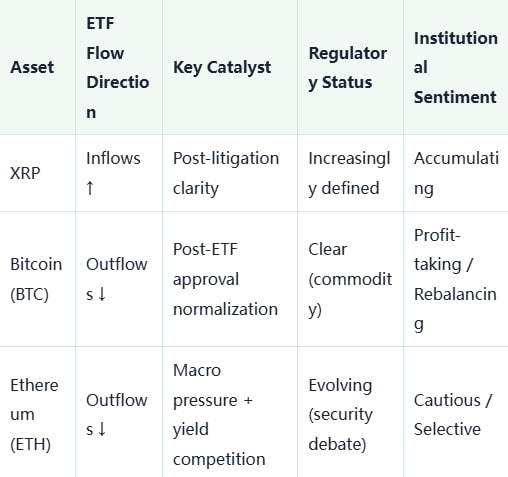
The Divergence at a Glance XRP ETF Flow Trend: Net Inflows ↑ Bitcoin ETF Flow Trend: Net Outflows ↓ Ethereum ETF Flow Trend: Net Outflows ↓ Key Regulatory Driver: SEC Lawsuit Settled XRP Market Cap Rank: Top 5 Crypto Narrative Shift: Utility > Store of Value Why XRP? Why Now?
The single biggest unlock for XRP's institutional credibility was the resolution of the SEC's long-running legal battle with Ripple. For years, the regulatory cloud over XRP kept cautious institutional allocators on the sidelines — compliance teams simply wouldn't sign off on an asset with open litigation risk. Once that overhang began to clear, XRP transformed from a legally ambiguous token into something institutions could actually underwrite. That's not just a sentiment shift — it directly affects product availability. ETF issuers need regulatory predictability to build and maintain compliant products. With XRP's legal status increasingly clarified, the infrastructure for institutional-grade ETF exposure has rapidly followed. Meanwhile, Bitcoin and Ethereum face a different kind of pressure. After the initial euphoria of spot ETF approvals, the 'buy the news' cycle has played out, and some early institutional entrants are booking profits or rebalancing into assets with fresher catalysts. XRP is, effectively, where BTC was at the dawn of its ETF era — earlier in the institutional adoption curve. Institutional Appetite: XRP vs. BTC vs. ETH ETFs
The 'Regulatory Clarity Premium' Is Real Institutions don't just buy assets — they buy certainty. Every basis point of legal uncertainty has a cost when you're managing other people's money. This is the core reason the XRP narrative is resonating with allocators right now: clarity, however partial, is worth a premium.
Bitcoin's regulatory status as a commodity is settled. Ethereum's is still debated. XRP's journey through the courts has ironically left it with one of the more documented legal track records in crypto — and documentation is something compliance departments can actually work with.
This doesn't mean XRP is 'safe' in any investment sense. It means the specific type of risk that scares institutional gatekeepers most — regulatory uncertainty — is relatively lower than it was 24 months ago.
The Utility Narrative Is Doing Heavy Lifting Beyond legal clarity, institutions are increasingly attracted to XRP's payments and cross-border settlement story. In a higher-for-longer interest rate environment, the cost of moving money across borders is under scrutiny. XRP's core use case — fast, low-cost international settlements via the RippleNet ecosystem — gives institutional investors a functional story to tell their LPs. 'We're investing in financial infrastructure' is an easier pitch than 'we're investing in digital gold.'
Bitcoin's store-of-value narrative remains powerful, but it's a well-told story. XRP's payments utility pitch is, for many allocators, newer territory — which means there's perceived upside in narrative adoption alone, separate from any price movement.
Three Forces Driving the XRP ETF Rotation Regulatory Unlocking (Legal Catalyst) The settlement trajectory with the SEC removed the single biggest compliance barrier for institutional XRP exposure. ETF issuers moved fast once the path cleared.
Fresh Adoption Curve (Timing) BTC and ETH ETFs already had their institutional 'rush moment.' XRP ETFs are at the beginning of that same curve — earlier allocators are positioning ahead of broader adoption.
Payments Utility Story (Narrative) In a macro environment where real-world asset tokenization and cross-border payments are hot themes, XRP's core use case aligns better with current institutional talking points than a pure store-of-value play.
What to Watch Next Further ETF approval decisions from regulators — any expansion or restriction of XRP ETF products will be a major flow signal Ripple's ongoing partnerships and RippleNet adoption metrics — institutional interest tracks real-world utility progress Macro interest rate direction — risk appetite broadly affects how aggressively institutions will rotate into altcoin ETFs Bitcoin ETF flow stabilization — if BTC outflows reverse, it could signal risk-on rotation reversing too Ethereum's regulatory status resolution — a clearer ruling could reroute some XRP-bound flows back to ETH New institutional products (futures ETFs, options, structured notes) built around XRP — product availability drives allocator access FAQ Are XRP ETF inflows guaranteed to continue? No. Capital flows are dynamic and can reverse rapidly based on regulatory developments, macro conditions, or shifts in institutional risk appetite. Current inflows reflect current sentiment, not a guaranteed trend.
Does institutional buying of XRP ETFs mean the price will go up? Not necessarily and not directly. ETF flows reflect demand for the product, which can influence underlying asset prices, but many other factors — liquidity, macro environment, market sentiment — play significant roles. No outcome is predictable.
Why would institutions sell Bitcoin ETFs if BTC is considered the safest crypto? Institutions operate on cycles of entry, profit-taking, and rebalancing just like any other market. Some early BTC ETF adopters may be rotating into assets they see as earlier in their adoption curve, not abandoning crypto altogether. It's portfolio management, not necessarily a bearish call on Bitcoin.
How is an XRP ETF different from just buying XRP directly? An ETF wrapper allows institutional investors to gain exposure through regulated, custodied, and compliance-friendly vehicles — without needing to manage crypto wallets, private keys, or direct exchange accounts. For large allocators, the ETF structure is often a prerequisite, not an option.
Is XRP's legal situation fully resolved? The situation has significantly improved compared to previous years, but the regulatory landscape for crypto broadly remains evolving. Investors and institutions continue to monitor official rulings and any new regulatory guidance closely.
This content is for informational purposes only and does not constitute financial, investment, legal, or tax advice. Cryptocurrency markets are highly volatile and speculative. Past performance and flow trends are not indicative of future results. All investment decisions carry risk, including the possible loss of principal. Always conduct your own research and consult a qualified financial advisor before making any investment decisions. The data and narratives referenced reflect publicly available information and general market observations; no specific investment outcome is implied or guaranteed.