
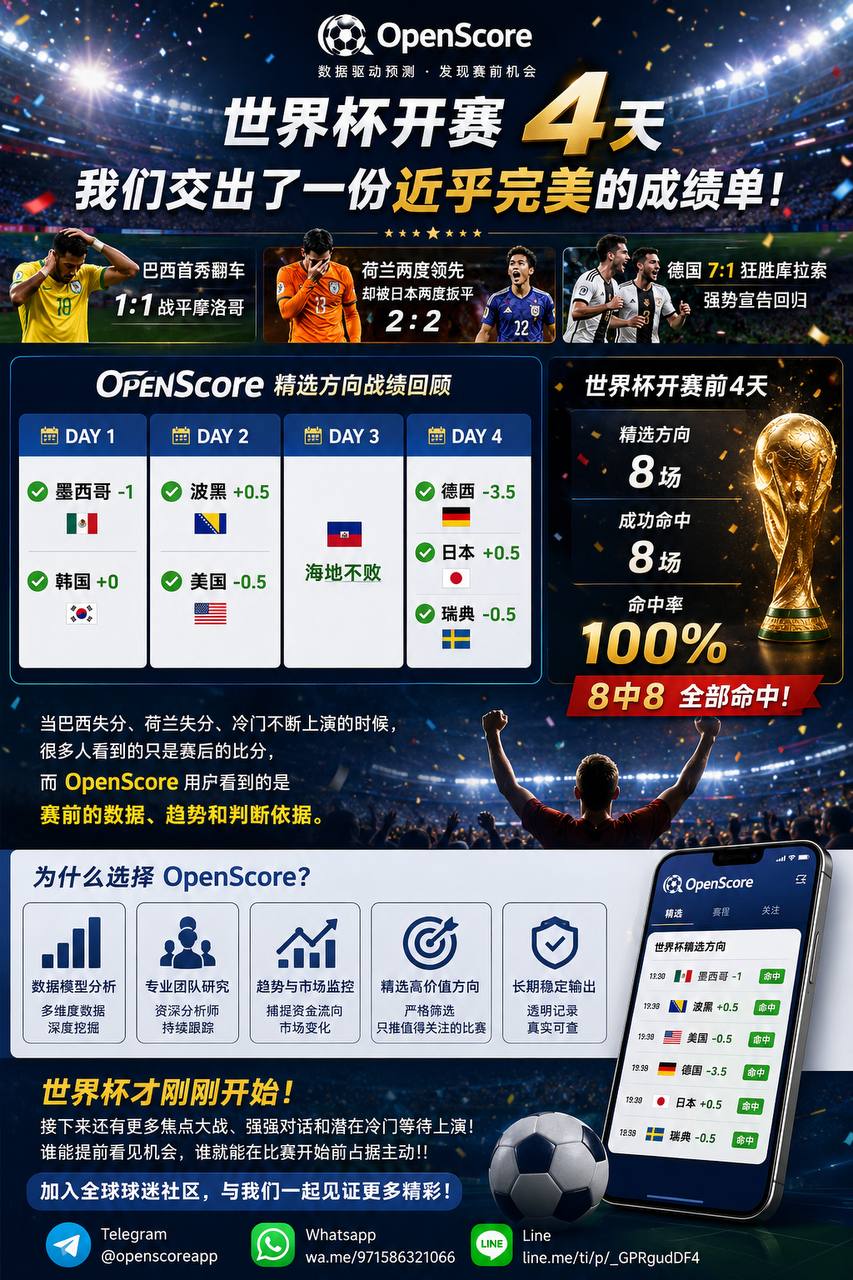
After the first round of matches, many highly anticipated teams failed to demonstrate the dominance expected. Brazil, considered one of the title favorites, struggled to break the deadlock against Morocco, ultimately settling for a draw; the Netherlands twice took the lead but couldn't shake off the tenacious Japanese team; meanwhile, Germany reaffirmed their competitiveness with a resounding victory.
The message behind these matches is clear—the World Cup is never a contest of paper strength.
Favorites are not a guarantee of victory.
World Cup Fan Community:Telegram: @openscoreapp
WhatsApp: wa.me/971586321066
Before each World Cup, the outside world compiles lists of so-called favorites based on player valuations, team rankings, and recent performances.
However, the World Cup is unique in that it's a short-term, high-pressure tournament.
Team form, player injuries, tactical changes, match pace, and even the stadium environment can all be crucial factors influencing the outcome of a game.
The past few days of matches have demonstrated that:
Some underestimated teams possess unexpected competitiveness;
Some strong teams still need time to find their rhythm;
And the details overlooked by the market are often more important than surface-level statistics.
What truly determines a match is pre-match information.
Many fans are accustomed to discussing results after the game.
Who underperformed?
Who missed opportunities?
Who should bear the responsibility?
However, for those who follow the tournament closely, the more valuable questions are:

Before the match began, were there any noteworthy signals?
What was the team's recent form?
Was the starting lineup complete?
Was the tactical approach suitable?
Were there any discrepancies in market expectations?
These pieces of information are often more valuable for post-match analysis.
Because after the match, everything is already a result; what truly tests judgment is the understanding of the game's trajectory before it begins.
In the data age, football analysis is changing.
With the development of data analytics technology, more and more fans are using professional tools to assist in observing matches.
The past reliance on experience and intuition is gradually being supplemented by data models, team performance analysis, and market change tracking.
This does not mean that predictions will always be correct.
Football always has an element of chance.
But data can help people identify potential risks earlier and can also help fans understand why some matches produce results completely different from what the public expected.

As the qualification situation becomes clearer, each team will face greater pressure and challenges.
Some teams need to prove they still have the ability to contend for the title;
Other teams hope to continue playing the role of spoiler;
And more unexpected twists and turns may be on the way.
The World Cup is never short of upsets.
What's often lacking is simply the perspective to spot opportunities in advance.
What will you be paying attention to before the next match?
Join the OpenScore official community:
Telegram:

WhatsApp:

Line: